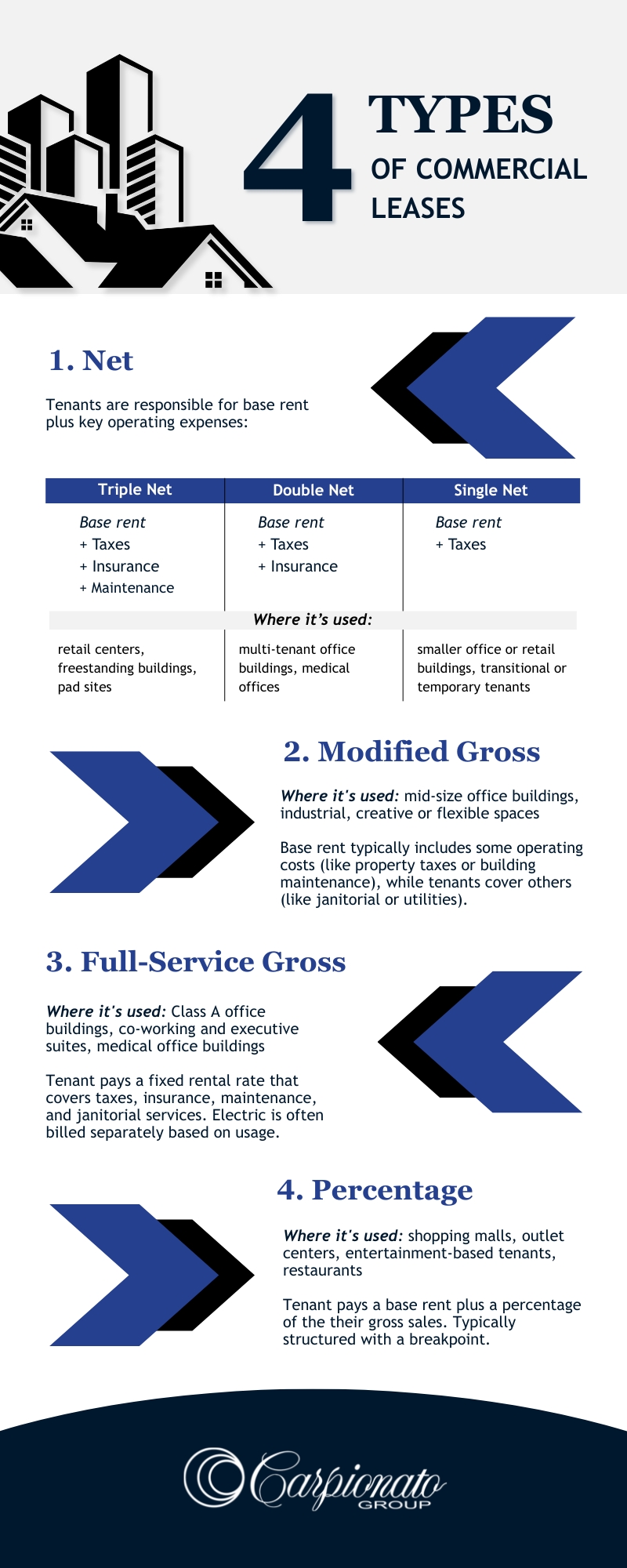
Entering into a commercial lease is a significant step for any business. For landlords, offering the right lease structure ensures a balanced relationship where tenants can thrive while property operations remain stable and well-managed.
There’s no one-size-fits-all lease — different businesses have different needs, and various lease types can provide the right combination of predictability, flexibility, and shared responsibility.
Below is an overview of the most common types of commercial leases offered across professionally managed retail, office, and mixed-use properties.
1. Triple Net Lease (NNN)
Where it’s used: retail centers, freestanding buildings, pad sites
Tenants are responsible for base rent plus three key operating expenses:
This structure shifts day-to-day operating costs to the tenant, allowing the landlord to maintain consistent rent collections. Tenants benefit from lower base rent and more direct control over their operating expenses.
2. Double Net Lease (NN)
Where it’s used: multi-tenant office buildings, medical offices
Tenants pay base rent plus:
The landlord typically remains responsible for common area maintenance (CAM) and structural repairs. This lease type strikes a balance—offering landlords some cost recovery, while simplifying overhead for tenants.
3. Single Net Lease (N)
Where it’s used: smaller office or retail buildings, transitional or temporary tenants
Tenants pay base rent plus:
The landlord retains responsibility for insurance and maintenance. This structure still provides some cost relief to the landlord but places fewer operational burdens on the tenant compared to NN or NNN leases.
Where it’s used: mid-size office buildings, industrial, creative or flexible spaces
This lease type blends elements of net and gross leases. Base rent typically includes some operating costs (like property taxes or building maintenance), while tenants cover others (like janitorial or utilities).
It provides more budget predictability than a full triple net lease, with shared responsibility between both parties.
Where it’s used: Class A office buildings, co-working and executive suites, medical office buildings
Tenants pay a fixed rental rate that covers taxes, insurance, maintenance, and janitorial services. Tenant electric (individual suite utilities) is often excluded from the lease rate and billed separately based on usage (either sub-metered or pro rata).
This simplifies budgeting for tenants and minimizes surprise costs. For landlords, it ensures full control over building operations and expenses.
Where it’s used: shopping malls, outlet centers, entertainment venues, restaurants
This lease includes a base rent plus a percentage of the tenant’s gross sales. Typically structured with a breakpoint (a minimum sales amount before percentages apply).
It allows lower upfront rent in exchange for a share of success. This model aligns both landlord and tenant goals in high-traffic locations.
When offering space to a prospective tenant, it’s important to consider:
Before signing, both landlords and tenants should clearly understand the financial and operational responsibilities outlined in the lease. A thoughtfully structured lease benefits both landlord and tenant, fostering long-term stability and successful occupancy.
Peter Flynn
Joe Pierik