Adriana Bruzzese
In commercial real estate, location is often the single most important factor influencing success. Whether you are a business owner selecting your next site or a real estate professional advising clients, choosing the right location can be the difference between steady growth and constant struggle.
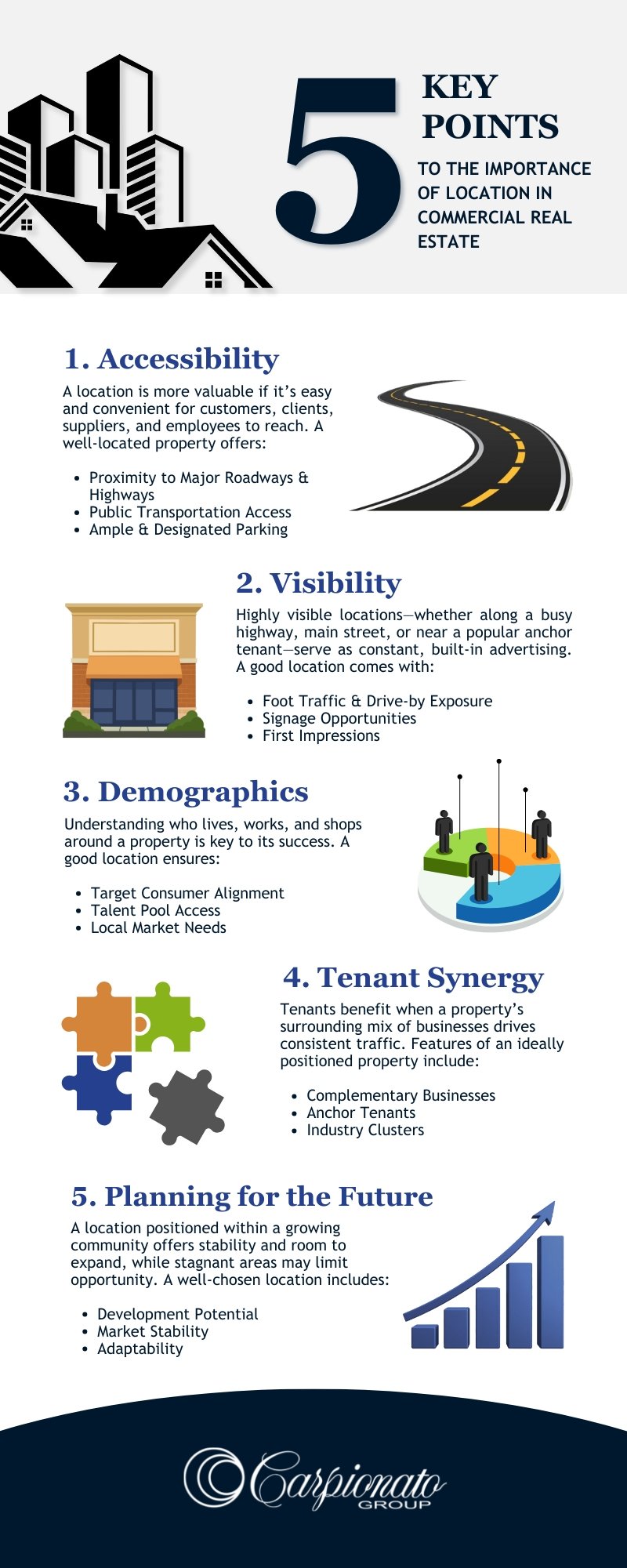
A location is more valuable if it’s easy and convenient for customers, clients, suppliers, and employees to reach. Ample parking, clear signage, and smooth traffic flow all contribute to a property’s accessibility. Proximity to major highways, public transportation, or densely populated residential areas can significantly expand a business’s customer base by making visits more convenient. For tenants, a location that is simple to navigate not only attracts more traffic but also improves the overall customer experience, encouraging repeat visits. A well-located property offers:
Proximity to Major Roadways & Highways: Essential for distribution, commuting, and customer visits.
Public Transportation Access: Crucial for attracting a diverse workforce, especially in urban or suburban centers.
Ample & Designated Parking: A non-negotiable for most retail and office tenants, ensuring convenience for everyone.
An inconvenient location can quickly become a barrier to growth, impacting everything from staffing to customer footfall.
For tenants, a property’s visibility is just as important as its square footage. Highly visible locations—whether along a busy highway, main street, or near a popular anchor tenant—serve as constant, built-in advertising. Even when customers don’t immediately stop in, consistent exposure helps build brand recognition over time. A well-placed storefront not only captures impulse visits but also reinforces credibility, signaling stability and trustworthiness over time.
For retail, restaurant, and even some office businesses, a prominent location is a marketing tool in itself.
Foot Traffic & Drive-by Exposure: High-visibility spots on busy streets or within popular shopping centers guarantee organic exposure.
Signage Opportunities: Prime locations often come with better opportunities for impactful external signage, enhancing brand recognition.
First Impressions: The surrounding area and immediate neighborhood contribute to a customer’s initial perception of your brand.
Commercial real estate professionals spend significant time studying who lives, works, and shops nearby. A fitness studio thrives in a community with health-conscious, active residents; a medical office relies on proximity to growing neighborhoods; and luxury retailers seek high-income households. For tenants, aligning their business with the right demographic mix ensures long-term viability.
Understanding who lives, works, and shops around a property is key to its success. A good location ensures:
Target Consumer Alignment: Is the demographic profile (age, income, lifestyle) of the area a match for your customer base?
Talent Pool Access: For office and industrial tenants, a location near residential areas or with good transport links is vital for attracting and retaining skilled employees.
Local Market Needs: Identifying underserved areas allows businesses to fill a market void, leading to quicker success.
Location is not just about geography—it’s also about neighbors. Tenants benefit when a property’s surrounding mix of businesses drives consistent traffic. For example, restaurants and various retail support services (hair salons, nail salons, gyms, fitness studios) often cluster near shopping centers anchored by grocery stores, while professional offices gain credibility and exposure in established business districts with retail amenities close-by.
A property’s neighbors can be just as important as the property itself.
Complementary Businesses: Being near businesses that attract a similar clientele can create a vibrant ecosystem where everyone benefits. Think a popular restaurant next to a theater, or a gym near an office complex. The synergy that’s created often results in increased dwell time at the properties.
Anchor Tenants: For retail, being part of a center with a strong anchor tenant can guarantee consistent foot traffic.
Industry Clusters: For office and industrial, being near other businesses in your sector can foster collaboration and a shared talent pool.
A location should work today but also support tomorrow’s growth. Tenants and advisors should evaluate factors such as upcoming new residential and commercial developments, infrastructure improvements, or municipal investments. A location positioned within a growing community offers stability and room to expand, while stagnant areas may limit opportunity.
A well-chosen location isn’t just about today’s needs; it’s about future-proofing your investment.
Development Potential: Locations in growing areas or those earmarked for infrastructure improvements can see significant appreciation.
Market Stability: Properties in established, desirable areas tend to hold their value better through economic shifts.
Adaptability: A prime location provides flexibility if a business needs to pivot or expand, as the supply/demand dynamics for the space will likely remain favorable.
While lease terms, square footage, and buildouts all matter, location is the foundation of success. It’s the one factor that can’t be renovated or redesigned, and the most important element in any real estate decision. For tenants, being in the right place is often more important than being in the biggest or newest space. Customers compare convenience, accessibility, and surrounding options when deciding where to shop, dine, or work. Commercial real estate professionals can guide tenants toward sites that provide long-term competitive advantages.
An asterisk (*) indicates a required field.